I understand transitioning to an unprocessed kitchen can seem overwhelming, especially if you’re just learning about things like organic whole cane sugar and coconut oil. I assure you — you can do it!
There is a simple and practical way to make the change. The first step is to go through your pantry and fridge and read every label, identifying the foods with processed ingredients (see list below) as well as preservatives and additives. This will begin to help you identify the foods you will eventually eliminate. You may want to start with the foods in the pantry wrapped in cardboard or plastic – those probably have the most preservatives, additives, etc. When you’re ready to start the change, begin by making one change every week. Discard one item and replace it with one new organic/unprocessed item in your pantry. After six months you’ll be amazed at how much change has occurred, and in a year or so, your entire pantry and fridge will be completely transformed. This was the approach I took because at the time I had two little kids and trying to convert everything at once was too daunting.
Having a well-stocked pantry and fridge is the first tool to help you cook nutritious meals at home and resist the temptation to purchase quick, take-out foods.
Here’s a photo of my pantry. I buy a few jars every couple of months so I can store all of my dry foods/ingredients in them.
Below you’ll find a few checklists to help you clean out your kitchen and replace those foods with nourishing, whole, organic ingredients. For these lists, I’m not going to zero in on one certain diet (grain free, paleo, gaps, etc.) nor is this a complete comprehensive list. Instead, I’m going to focus on getting rid of processed foods and replacing them with unprocessed foods. You can choose which foods you add to your pantry according to the diet you follow.
Ingredients/Foods to Avoid:
- Hydrogenated oils and trans-fats
- White flour
- White sugars
- Agave (click here to read more about this sweetener)
- High fructose corn syrup or corn syrup
- All vegetable oils (corn, canola, etc.)
- Soybean oil
- Any food with ingredients you can’t pronounce.
- Any food with ingredients that weren’t around a few hundred years ago – If your great-grandma wouldn’t recognize it, consider removing it.
Foods/Ingredients to Add:
Oils and Fats:
- Extra-virgin, cold-pressed olive oil
- Virgin coconut oil
- Raw, unsalted butter
- Red palm oil (make sure to purchase from a company that uses sustainable practices)
- Sesame oil
- Ghee (click here for an easy homemade recipe)
- Lard or Tallow from grass-fed, organic cows
In the Fridge:
- Fresh fruits and vegetables
- Pastured, organic meats
- Organic eggs (pastured preferred)
- Raw, organic cheese
- Nut and seed Butters
- Whole plain yogurt
- Pastured unsalted butter
- Raw milk and cream
- Crème fraiche or a cultured sour cream
- Kombucha
- Ohsawa nama shoyu fermented soy sauce, tamari sauce or coconut aminos
- Raw apple cider vinegar
- Chicken Stock (Homemade preferred)
- Unprocessed condiments such as homemade ketchup, mayonnaise, dijon mustard, etc.
Sweeteners:
- Raw honey
- Maple syrup
- Molasses
- Maple sugar
- Whole cane sugar or Sucanat
- Coconut Sugar
- Coconut Nectar
Dry and Other Pantry Ingredients:
- Almond Flour
- Coconut Flour
- Whole wheat berries to grind for flour (preferably ancient grains such as emmer wheat, but only if your body can tolerate grains)
- Gluten Free flours (if you can tolerate grains)
- Raw cacao powder
- Pure vanilla extract
- Almond extract
- Aluminum-free baking powder
- Arrowroot powder (I use this as a 1:1 substitute for cornstarch)
- Unflavored Gelatin (I use this as a binder in many gluten-free/grain-free recipes)
- Celtic sea salt
- Dried Beans
- Nuts such as almonds, cashews, pecans, etc.
- Loose leaf tea
- Dark chocolate (preferably without soy)
- Herbamare is a fantastic all-purpose seasoning mix
- A few favorite spices and herbs: Dried Italian seasoning, dried thyme, ground cumin, ground cinnamon
- Coconut Milk
- Onions, Garlic, Squash
As you make the change to unprocessed foods, you’ll need jars or containers in which to store your ingredients. I store my foods in Mason jars or the flip top Bormioli Jars. Mason jars can be found at most grocery stores and the Bormioli Jars can be found at Sur La Table (they frequently have sales!) or I hear they carry them at World Market.
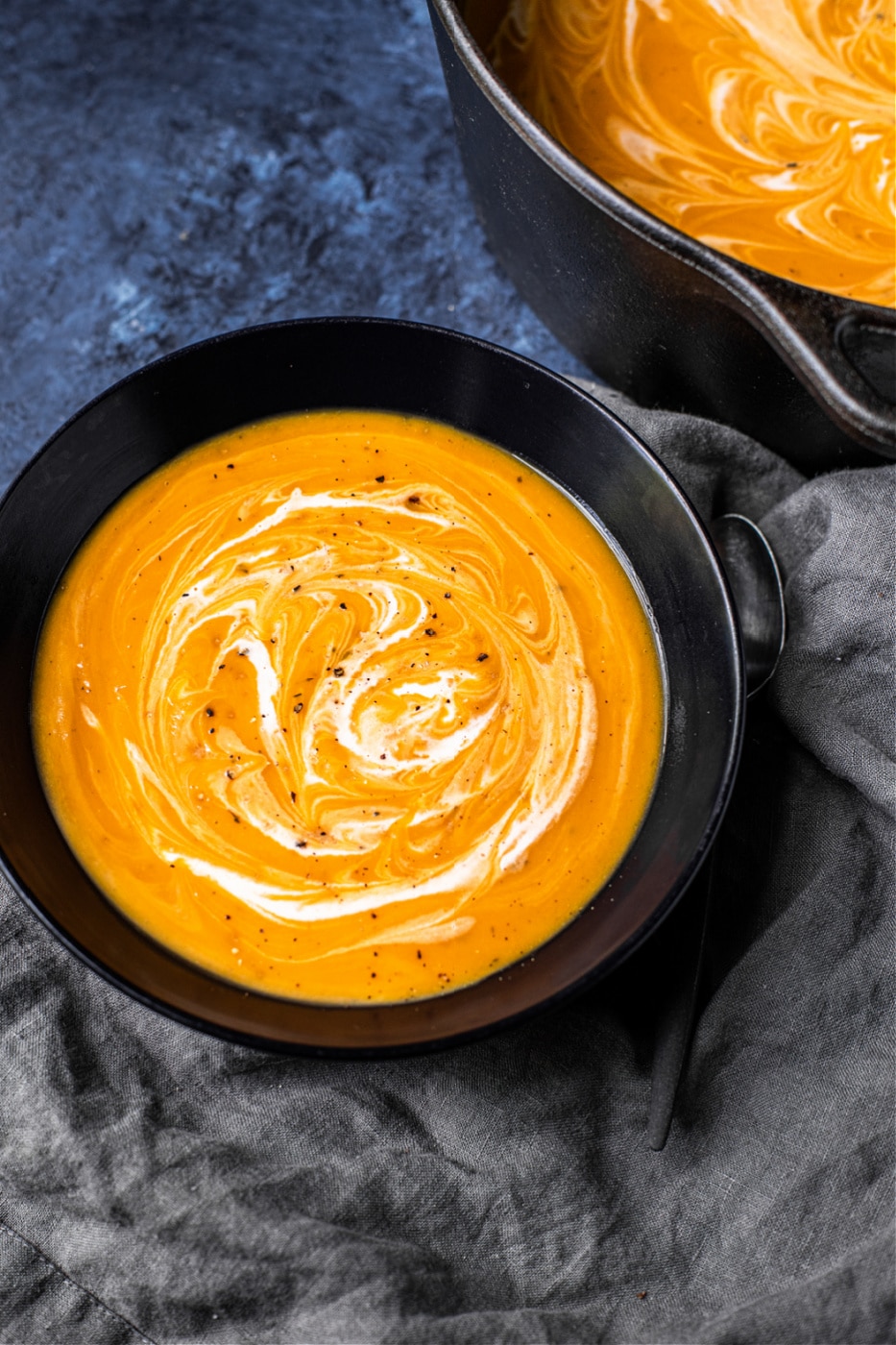
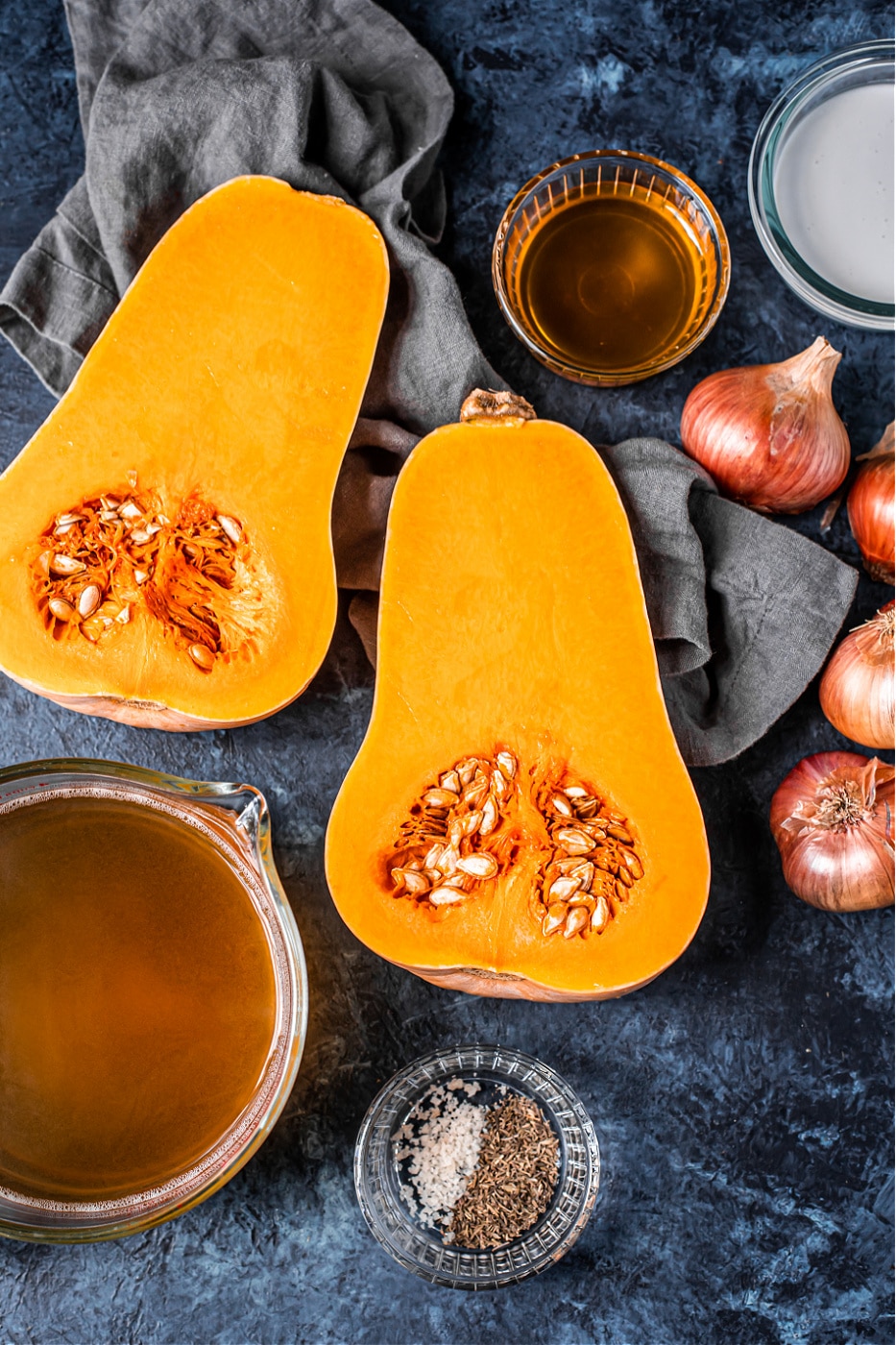
During the cooler months, I make a pot of soup at least twice a week. They’re easily put together – utilizing many pantry and fridge staples – are full of nourishing ingredients, and the leftovers make for a fantastic lunch the next day. I usually go for a creamy soup and this butternut squash concoction fits the bill. The shallots (they can be found near the onions at the grocery store) are cooked slowly in unsalted butter, the squash is roasted to bring out the sweetness and then it’s combined with chicken stock, a bit of coconut milk, and thyme to round out the flavors.
Here are some other soups you might enjoy:
Creamy Chicken, Vegetable and Tomato Soup
Lentil, Carrot and Kale Soup with Creme Fraiche
Cream of Tomato Soup
Tortilla Soup
If you’d like to download the above lists in a pdf format, click here.
Butternut Squash Soup
Serves 4-6
4 tablespoons ghee, divided (click here for an easy homemade recipe)
4 shallots, chopped
1 large butternut squash, peeled and cut into large bite-size pieces
1/2 teaspoon Celtic sea salt plus more for seasoning
1 teaspoon dried thyme
6 cups chicken stock (homemade preferred)
1/2 cup coconut milk
Directions:
Preheat oven to 400ºF and adjust rack to middle position. Place 2 tablespoons ghee in a large pot over medium heat. Add shallots and stir. Reduce heat to low, cover pot with a lid and cook for 20 minutes.
Toss butternut squash with remaining 2 tablespoons melted ghee and spread evenly on a large baking dish. Season with sea salt. Roast for 15 minutes. Using a spatula, flip the butternut pieces and then roast for an additional 15 minutes, or until the squash is golden brown on the outside and soft on the inside.
Stir dried thyme into shallot mixture until fragrant, about 30 seconds. Pour in stock and add butternut squash. Bring to a simmer and cook for 15 minutes. Using a hand-immersion blender, blend soup until smooth (or you can spoon the soup into a blender and blend until smooth). Stir in coconut milk and season with sea salt. Serve.
Posts may contain affiliate links. If you purchase a product through an affiliate link, your costs will be the same but Deliciously Organic will receive a small commission. This helps cover some of the costs for this site. We appreciate your support!


{ 47 comments… read them below or add one }
Hi Carrie! Great post in organizing your unprocessed kitchen! I think many people come to a roadblock on how to properly stock their kitchen pantry when making the switch to unprocessed foods. This list is so helpful!
The butternut squash soup sounds delicious too!
Thanks, Heather!
I pretty much dove in head first a couple months ago and I am pleased to say I have restocked with mist of the items you have suggested. It took a little bit to make the transition but is well worth it!
I do want to thank you Carrie for being so diligent with this site. It has become my daily “go-to” site for inspiration. I know from experience that it takes a lot to keep a successful online presence going. In fact, i had to lay mine aside when my life was blessed with 3 newborn babies in an eleven month period.
I don’t take what you are doing lightly. It has become a huge gift to many of us! Thanks again!
Thank you Jennifer. I really appreciate your kind words!
Great post! I’ve been un-processing my kitchen for over a year, and it’s amazing how far baby steps can take you. Question about the soup – which looks wonderful, by the way! Can butter and whole milk be substituted for the ghee and coconut milk? Are those ingredients necessary for the flavor profile or simply to make the soup dairy free? I have not put ghee or coconut milk in our budget, but we do use raw milk. Thank you!
I’m glad to hear that you’re making progress! Butter can be used for the shallots, but I wouldn’t use it to roast the squash because it could burn. Ghee is really easy to make yourself, here’s a recipe: http://deliciouslyorganic.net/how-to-make-ghee-clarified-butter/ You can use heavy cream in place of the coconut milk.
Thank you! I will certainly look at the ghee recipe. Thanks again!
Thanks so much for all this info. You got me looking deeper into the types of oils and fats I use in my kitchen. I do have one question though. Is peanut oil one that should be avoided? I’m looking for a canola replacement and need something high heat that won’t impart a flavor to the foods. Thanks again!
You’re welcome! From my understanding, peanut oil can be used in strict moderation (these’s some good info about peanut oil in this article: http://www.westonaprice.org/know-your-fats/skinny-on-fats). I would look for a peanut oil that has been minimally processed. I have grown very fond of ghee as of late for high temp cooking. For frying I use lard (although that can impart a bit of flavor to the foods).
Thanks so much!
Great post! Thanks for providing do-able baby steps. We’re just starting to change over to an unprocessed kitchen and it seems so overwhelming. I can’t wait to follow along with the rest of the process.
Such amazing info Carrie! You present it in a way that seems even *I* could do it. And such beautiful photos!
Thanks, Amanda!
I made a very similar butternut squash soup recently but used ginger instead of thyme – very nice pairing with the coconut milk! Yum!
Awesome healthy tips!! This soup I need after a long day on the slopes!
I am with you, Carrie on the unprocessed quest. Great post – you are going to help a lot of people.
Carrie, I LOVE your blog. I have been following for some time and it is such a great motivator. Within the past year, our fridge and pantry have taken on much of the same identity as yours
. I’ve made tons of recipes off your site and constantly recommend them to friends and family. Keep up the good work!
Thank you, Mel. I appreciate the kind words. I’m so glad you’ve been able to make some great changes!
Too funny – I just mad a similar Acorn Squash Soup last night (post coming soon on mumzstuff.wordpress.com) I find you don’t even need the stock, which makes it a bit easier and limits the chance of grabbing a processed soup stock.
Your looks delicious, I will try this on next!
Thanks!
Gorgeous Soup Carrie- healthy and incredibly delicious, butternut squash is always a favorite of mine.
Thanks Carrie – great post! I like having a list of items to reference.
I’ll be honest and say that I probably won’t give up all my food vices, but, you have really opened my eyes concerning food/nutrition, and I am now much more aware of what I eat/buy.
Keep up the good work! I’m looking forward to more posts along these lines.
Thanks Erika!
mmm love butternut squash and I will definitely try the coconut milk addition. Such a great post to inspire me to cook and eat healthier!
This is a really great post. I’ve shared it on Facebook and hope that many people will begin to move in this direction (especially some of my family members).
I pretty much adore the picture of your pantry. Glass jars…be still my heart!
Thanks, Stacy!
Carrie, your soup looks BEAUTIFUL and delicious! I love the helpful information you’ve shared, too. THANK YOU!
My concern/question is this. Why do so many healthier recipes, especially baked goods, call for coconut products (oil, flour, etc)? I thought it was very high in fat (albeit healthy fat)
Unfortunately, I’m severely allergic to all forms of coconut, and frankly, olive oil just doesn’t make a suitable alternative for it in baked goods.
What would you suggest I substitute in lieu of coconut oil and in lieu of coconut flour? Wheat flours make baked goods too tough (imho). If I’m going to stand any chance at being able to switch to an unprocessed lifestyle, I’m going to have to find products that allow me to feel like I’m still indulging in my favorite carb-loaded treats. Know what I mean?
The fat in coconut oil is very healthy, so I think that’s why so many healthier baking recipes call for coconut ingredients. You can usually use butter as a substitute for coconut oil. Ghee is also a great option. In most of my grain-free baking recipes, I use just a bit of coconut flour to help add more stability to the end product. You can omit the coconut flour (for most recipes) and add a few extra tablespoons almond flour and a bit more gelatin. The end result might be a bit more crumbly than I originally intended, but it will still taste great!
Hi Carrie,
Thanks for the list! Two questions. First, is grapeseed oil an ok oil to use? Finally, I’ve been hearing that the gums in many items, e.g., cream cheese, etc. , are not that great for us. Is this true, or is it just carrageenan that’s the problem? I ask because native forest coconut milk has a gum in it as well and I’ve been unsuccessful in finding canned coconut milk that doesn’t have anything in it but coconut milk
Thanks!
“Grapeseed oil contains phenols that raise the smoke point. However it is very high in omega-6 fatty acids, so it not a good choice for our diets–we need to avoid excess omega-6 fatty acids as much as possible. Also, grapeseed oil is industrially processed with hexane and other carcinogenic solvents, and traces will remain in the oil.” Dr. Mary Enig
Many commercial cream cheeses and such contain preservatives that aren’t very beneficial. I’m ok with some gums, such as arrowroot and gelatin and a little bit of guar gum because it comes from the guar bean. There are some brands that don’t contain any preservatives (Wilderness Family Naturals sells a coconut oil that doesn’t contain any guar gum) and you can also make the cheeses at home using starters from http://www.CulturesForHealth.com. Some other gums, such as carrageenan are much more highly processed and have found to be carcinogens. I avoid all products with carrageenan. Here’s a handy list of companies that don’t use carrageenan in their products: http://www.cornucopia.org/2012/05/shopping-guide-to-avoiding-organic-foods-with-carrageenan/
Hi Carrie,
I am confused about what type of oil to regularly cook with. My son is allergic to eggs, milk, wheat,soy and peanuts. I am currently using Canola. What is a healthy option that will agree with my son?
Thanks for any suggestions you have.
Hi, Lori,
I’m not Carrie, but I am a real food cook as well. ; ) Extra virgin olive oil and coconut oil are the best for cooking (I would say butter, too, but for the milk allergy) as you can cook them to relatively high temps without them going rancid. Most other cooking oils out there either go rancid or turn to trans-fats when heated.
I personally avoid canola oil. Here is one website that explains the problems with it: http://rense.com/politics5/dare.htm Here’s another one: http://www.livestrong.com/article/184705-canola-oil-health-risks/
HTH!
Lori – I suggest looking into coconut oil, ghee, lard, and olive oil. Here’s a fantastic article that lists all of the great properties and health benefits of each (the first part of the article is the history of fats/oils, so scroll down a bit and you’ll see their list): http://www.westonaprice.org/know-your-fats/skinny-on-fats
Also, if your son is dealing with lots of allergies, you should check out the Gaps diet. My nutritionist has a very informative site about this diet. My daughter did the Gaps diet last year and we saw so many amazing benefits from it! http://www.gapsinfo.com
THANK YOU!
I am a new reader.
God has been talking to me, for a few months, about some changes that my family needs to make. BUT, I wasn’t sure what. I had been batting around organic, gluten-grain free, grain free.
I discovered your blog and this is really settling well with me. Before I go totally crazy, I need to ease into it and focus on whole foods….unprocessed foods. I have 4 boys, and though it will be tough, my older 3 (aged 13, 12, and 9) will be open to trying….especially if it is healthy.
I look forward to following your blog!
~LL~
I’m glad you discovered this blog and I hope it can help you and your family make healthy changes!
Great tips for people just getting started! As for jars, DH used to drink black tea and needed to put honey in it, so I have saved a couple dozen empty raw honey jars and use to store things. Think things might last longer with a specially sealed top, but so far, they work for us.
Great idea!
Carrie- you’re so full of great tips!! I love reading your blog!
Another helpful thing I tell my friends/family is that if the ingredients list doesn’t read sort of like a recipe, it’s probably not good for you.
Great tip!
Hi Carrie, the soup recipe looks delicious.
Can I use vegetable stock in place of the chicken stock when preparing this meal for a vegetarian? Or if not vegetable stock, what would you recommend using?
Thank you!
A vegetable stock would be a great substitution. I don’t know of a brand sold in stores that doesn’t have extra preservatives, but you might be able to find some homemade stock at a gourmet market. Here’s a great vegetable stock recipe from Simply Recipes: http://www.simplyrecipes.com/recipes/how_to_make_vegetable_stock/
Hi Carrie, I’ve been reading your blog for over a year now (I got it from the Heavenly Homemakers site), and have learned lots from it. Thank you for sharing your valuable research with us!
I am wondering about using salted butter. You have “unsalted” butter listed in your fridge items. Besides the added salt, is there a difference between the two and is the unsalted healthier? Could I use salted butter and just decrease the salt in recipes that call for unsalted butter? I have also often wondered if store bought butter actually is pure or if it is modified.
Thank you.
I prefer unsalted butter because then I can control the amount of salt and also the source of salt in my cooking. You can use it in place of unsalted butter and reduce the salt in your recipe by about 1/4 teaspoon. Many organic butters sold in stores are great for cooking, but it’s important to know the company you are buying from. If you find a brand you like, you can always call the company and ask questions about their processing and such. Whenever I’ve done this, people are usually very helpful and offer up any info I ask for.
Just came to this accidentally and will be adding your blog to my regulars.
Re vegetable stock: I learned a great trick from a friend, so I thought I’d share. I collect the odds and ends from my preparations (carrot ends, green parts of leeks, onion peels and core, herb stems, corn cobs, shelling pea pods, etc.) in a freezer bag. When I have 1-2 bags and a little time, I fill up a stock pot, put the frozen stuff into a pasta strainer and set it in the stock pot. I add anything else I have and think should go in (parsnip, a knob of ginger…) bring it to a simmer, and leave it alone for an hour. The sopped vegetables go in the compost, and the broth into the freezer.
I also like to put squash guts in, but we got a puppy and she loves them so much I feel guilty taking them!
Great tip! Thanks!
Love your site! Any chance you’d be willing to make this list into a downloadable pdf?
Good idea! I’ll look into that and get it set up!
{ 12 trackbacks }