Last Updated on October 6, 2026 by Deliciously Organic Editor
Histamine intolerance has become a very common issue. When I was struggling with Hashimoto’s, I broke out into hives from every single food and yet all of my allergy tests came back negative. Thankfully, I was able to reverse my histamine issue.
In my functional nutrition practice I often see clients who test negative for all allergies, but they are still having symptoms of elevated histamine. Over the years, I’ve discovered simple steps that can reduce histamine intolerance naturally. Let’s dive in!
What is histamine intolerance
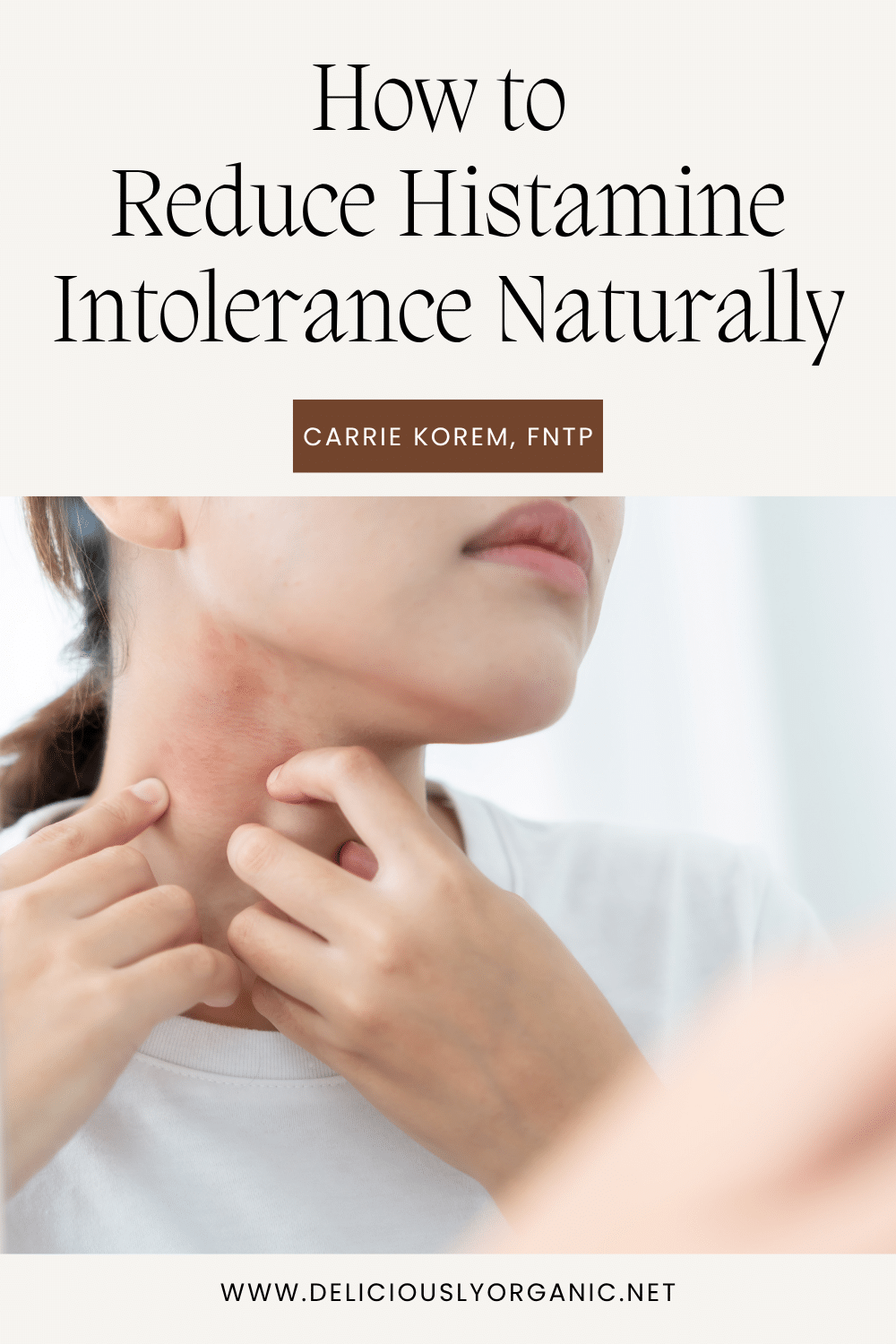
Histamine intolerance is when too much histamine is produced or the body can’t break it down sufficiently. This results in symptoms such as headaches, rashes, hives, digestive issues, etc.
Histamine intolerance causes
Here are the three most common root causes that I see in my practice:
1. Stress and poor gut health – when cortisol or adrenaline is released, this can result in a histamine release. Chronic stress also weakens the digestive system and can inhibit the production of enzymes such as DAO which is responsible for breaking down histamine.
This can create a vicious cycle and lead to many unbearable symptoms.
2. Poor liver health – good liver health and function is required to break down the histamine to then be excreted as waste. If the liver doesn’t have the tools it needs to carry out this process, histamine builds up in the body.
3. A disordered microbiome (aka gut dysbiosis). A microbial imbalance in the gut can inhibit the body’s ability to break down histamine.
When we work to reduce the chronic stressors, support the microbiome and a healthy digestive system and support the liver, we often see histamine reactions greatly reduce.
What about MCAS?
Mast cells are part of your immune system and they look for harmful invaders like viruses, bacteria, toxins, etc. They activate to help fight infections and regulate your organs. When mast cells are over protective and activate too much, this can cause an increase in histamine and allergic reactions.
MCAS isn’t fully understood and just because you have histamine intolerance doesn’t automatically mean you have MCAS.
In my practice, I’ve found it best to always work on the foundations because this will at least improve the symptoms and then it will become more clear what next steps need to be taken.
Histamine intolerance symptoms
Itching
Hives
Headaches
Migraines
Anxiety
Insomnia
Fatigue
Depression
Eczema
Histamine intolerance supplements
Antronex – this is my #1 supplement for histamine issues. It is an excellent liver support supplement and is made of bovine liver fat extract. It will help reduce histamine symptoms better than anything else I’ve found.
Cataplex B – GF – This provides good B vitamins to help support the adrenals and reduce stress in the body.
Betafood – This is my go-to for supporting the liver and gallbladder. It’s very gentle and is a good first step when struggling with histamine issues.
Nutra-Hist – This supplement supports mast cell and histamine release.
Thymex – This is an extract of thymus tissue and helps promote lymphatic drainage and stimulates general thymus immune response.
Cataplex C – Vitamin C can be helpful to reduce histamine in the body.
Spleen PMG – This helps support the spleen which is a blood filtering organ that plays an rimportant role in the immune system.
Rosmarinus Gemmotherapy – This therapy is very helpful to very gently drain the liver.
What foods should you avoid
A strict low histamine diet often backfires because the list of foods to eat is so small and is not nourishing enough to allow the body to heal.
I’ve found that the best course of action is to avoid the top offenders (this will look different for each person), and focus more on reducing the chronic stressors, eating nutrient-dense foods and supporting the liver.
Here are some of the top offending foods:
Alcohol
Fermented foods
Smoked or cured meats
Vinegar
Tomatoes
Citrus fruits
Shellfish
Canned fish or meat
Strawberries
Nuts
Tomatoes
Cacao
Is a food sensitivity test helpful?
I personally don’t think they are. The results will tell you what you’re reacting to, but it won’t tell you why. The “why” is the most important piece of the puzzle.
Most food sensitivities are from a gut issue which is usually leaky gut. Working on the root causes like the stress and gut health, can help you heal much more quickly than just avoiding a long list of foods.
Remember – the cells of the gut heal every 3-7 days, so healing the gut and reducing food sensitivities can happen within a matter of weeks to months!
4 Steps to Reduce Histamine Intolerance Naturally
1. Reduce chronic stressors – I cannot emphasize this enough. I’ve seen that this is always a root cause of histamine issues.
Here is a list of common stressors that I see in my practice:
Being in a hurry all the time
An over-scheduled life
Not eating enough food
Not sleeping enough – we need a minimum of 7 hours a night to be healthy and vibrant.
Processed foods
Not spending time outside each daily
Not enough movement
Nutrient deficiencies
EMFs – sleeping next to you phone your while it’s charging, being near wifi all day and when sleeping, wearing an apple watch or AirPods.
2. Eat slowly and in a rested state. When we eat slowly, the brain sends the signal to the stomach to make enough stomach acid. The saliva that we produce when chewing slowly, later triggers the pancreas to release digestive enzymes. Stomach acid is your first defense against parasites, bacteria, etc. and to keep your microbiome healthy.
We need a healthy microbiome to remove excess histamine from the gut, so eating slowly can make a huge impact.
While you’re working on this, taking a supplement like Zypan can be very helpful. It contains both hydrochloric acid and digestive enzymes to support a healthy digestive system.
3. Avoid all processed foods and eat a nutrient-dense diet. As I mentioned above, it can be helpful to avoid the top list of foods that increase your histamine issues, and then focus the rest of your attention on eating whole, real foods to nourish the body.
4. Spend at least 30 minutes outside daily. Studies have shown that time outdoors reduces cortisol and stress in the body. Reducing stressors can play a major role in reducing histamine.
5. Consider supplementation. The ones listed above are my top recommendations. And, be very careful to not take too many supplements or self-prescribe. Consulting with a nutritional therapist can be incredibly helpful to ensure you’re on the right supplements for your situation.
6. Support your liver gently – The key here is to take things slow.I do not recommend immediately hopping on castor oil packs, beet kvass, or lots of supplements. This will often backfire.
Start with reducing your stressors, switching to non-toxic products, and making sleep and spending time outdoors a priority. All of these things significantly help the liver!
As you combine these steps with a nutrient-dense diet, you should slowly start to feel better. Sometimes it takes clients a few weeks to start to see improvements in how they feel, so keep in mind this takes a little bit of time.
A liver supplement that I see help even the most sensitive clients is Betafood. It’s a very gentle support for the liver and gallbladder and can be a good first step to bring in some additional liver support.
Can you heal from histamine intolerance?
Yes! When the body is given the right tools, it can heal. I saw this happen in my own health and see it happen consistently for clients.
How can I learn more about the steps I can take for thyroid disease?
I have four fantastic options for you!
- To download my 50 of my top tips to support the thyroid naturally, tap here. I’ll also send you an educational email every few days to help you learn how to support your body naturally.
- If you’d like to learn from first steps you can take to help support your thyroid, check out my class, “5 Keys to Thyroid Hormone Balance”. It’s just 45 minutes and I promise you’ll learn something new!
- If you’re looking for a step-by-step plan for Hashimoto’s that truly works (no more piecing together info!), check out my 90-Day Thyroid Reset Program.
- Book a consult with me for one-on-one help. Here’s info about what working with me looks like.


I appreciate so much how you don’t throw all the things in at once. It makes a lot of sense when we are already dealing with stress. You are so NORMAL. And I mean that in a kind and loving way. I APPRECIATE YOU. So glad I found you those many years ago.
You’re welcome! I’m glad I’m “normal” 🙂
If only take a couple of supplements, which two would you suggest?
Without knowing your full health history, it’s hard to say what would be optimal. I recommend asking your nutritionist or functional practitioner.
I just received my order of Antronex. Do you take with food? Between meals? I can’t find instructions other than “one tablet per day.”
Eager to try for eczema.
It can be taken with meals or without. Legally, I can’t give dosing recommendations unless you’re a client. I recommend asking your nutritionist the right dosage for you.
I began taking the Antronex and had relief from hives almost immediately. I started with the “load” procedure from Kim and then backed down to the daily quantity on the bottle once I get the relief was holding. I plan to finish the bottle, is that recommended? Thank you for helping me make the right choice. I so appreciate you!
I’m so glad the antronex helped! We are all biochemically individual, so it’s hard to say how much you should continue taking. I recommend asking your practitioner.