Last Updated on June 15, 2026 by Deliciously Organic Editor
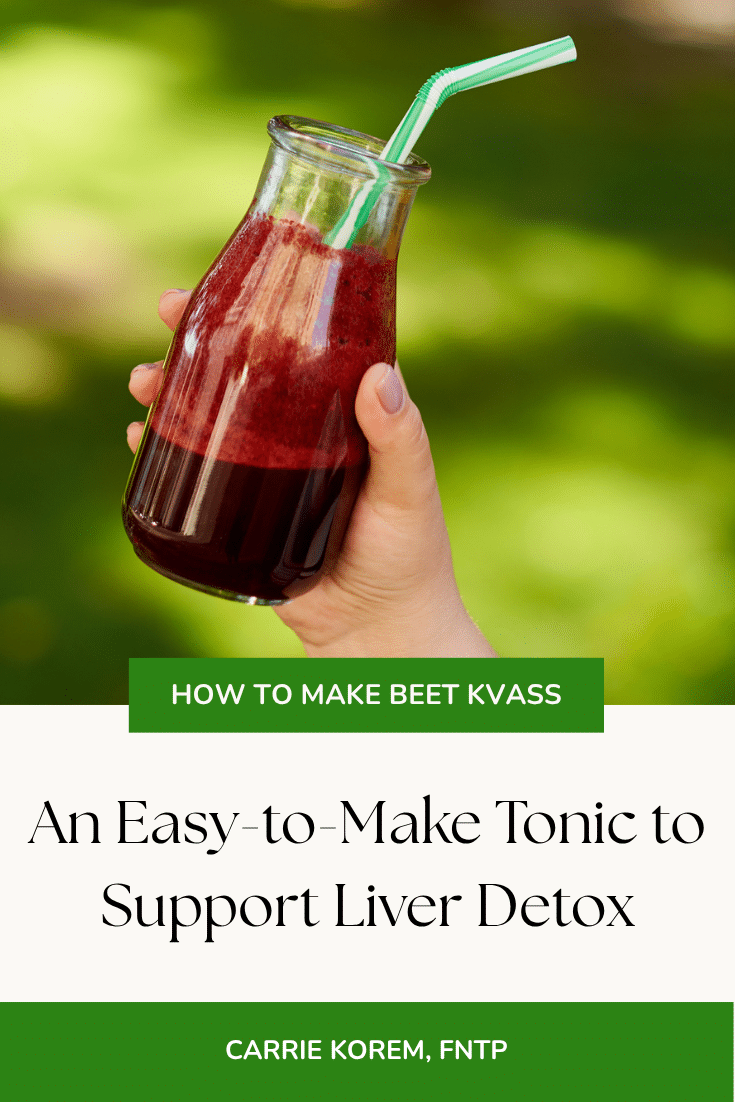
Beet Kvass is a traditional fermented Russian drink that supports healthy liver detoxification, contains various nutrients, and only requires 3 ingredients!
What Are the Health Benefits of Beet Kvass?
1. It’s a natural source of probiotics, B vitamins, vitamin C, and minerals like iron, calcium, magnesium, and potassium.
2. It supports healthy liver detoxification, helps thin the bile in the gallbladder, and can be a good treatment for kidney stones.
3. It’s very useful to drink prior to conception to help reduce morning sickness during pregnancy. Morning sickness is often rooted in liver congestion, so taking steps to support the liver for about 6 months prior to conceiving can help reduce morning sickness.
4. Brown spot on the cheeks or on the tops of the hands, also known as liver spots, can be reduced by drinking 4 ounces of kvass daily. If you have liver spots on the face or hands, I also recommend following these steps to help gently detoxify the liver.
5. Kvass benefits gut health and the digestive system.
What Does Beet Kvass Taste Like?
Beet kvass is a fermented food like sauerkraut or kimchi. It’s salty, sour and earthy. If you like the flavor of beets, you’ll most likely enjoy the flavor. I personally don’t love the flavor of kvass, but I drink it daily because it has so many health benefits!
How Do I Make Beet Kvass?
It’s actually a very simple combo of only water, salt and beets. Watch the video below for step-by-step instructions.
How Much Beet Kvass Should I Drink Daily?
I recommend starting with 3-4 ounces each morning on an empty stomach. Then, work up to drinking about 6 ounces a day.
What if the top of the kvass has bubbles or mold on it?
It’s common to have some white foam or bubbles on top after it has fermented. You can skim this off the top. If the kvass has green, black, brown, etc. mold on top, then I recommend starting over. You might find that in the warmer months that you need to ferment the kvass for a shorter amount of time.
What if the kvass has a thick consistency?
The kvass should be a thin consistency, similar to water. If it’s thick and viscous, then it fermented too long and it’s best to start over.
Is kvass considered safe when pregnant or nursing?
Yes, but if you’ve never consumed fermented foods before, then it might be best to avoid kvass and other fermented beverages right now. If you consumed them before pregnancy, then talk to your practitioner about the right amount for your situation.
How can I learn more about the steps I can take for thyroid disease?
I have four fantastic options for you!
- To download my 50 of my top tips to support the thyroid naturally, tap here. I’ll also send you an educational email every few days to help you learn how to support your body naturally.
- If you’d like to learn from first steps you can take to help support your thyroid, check out my class, “5 Keys to Thyroid Hormone Balance”. It’s just 45 minutes and I promise you’ll learn something new!
- If you’re looking for a step-by-step plan for Hashimoto’s that truly works (no more piecing together info!), check out my 90-Day Thyroid Reset Program.
- Book a consult with me for one-on-one help. Here’s info about what working with me looks like.
How to Make Beet Kvass
- Prep Time: 5 minutes
- Total Time: 5 minutes
- Yield: 2 Quarts
- Category: Beverage
- Diet: Dairy-Free, Gluten-Free, Keto, Low-Carb, Paleo, Pescatarian, Vegan, Vegetarian
Ingredients
- 3-4 small raw beets or 1 large raw beet, washed, ends trimmed and cut into 2-inch pieces
- 1 tablespoon Celtic sea salt
Instructions
- Place the beets in a 2 quart glass or ceramic pitcher. Cover with filtered water and stir in the sea salt. Cover with a clean cloth and place in a dark cool place for 3 days. After 3 days, remove the beets and store the kvass in the fridge (if there is foam on the top, just skim it off). It will keep for about 2 weeks.
- Note: It is important to chop the beets and not grate them. Grated beets will create too much juice and will ferment too rapidly, resulting in alcohol instead of lactic acid.
Nutrition
- Serving Size: 1


Thanks for this healthy, easy Beet drink recipe!
So many benefits!
I stored the kvass in my fridge instead of outside for 3 days will it still work?
It needs to sit at room temperature in order to ferment. Maybe leave it out for a few days and see how it does?
i got the giant cooked beets from costco
how can i use them in this recipe?
You need raw beets, so cooked wouldn’t work for this recipe.
Hi Carrie, love your site! I usually do hot water with lemon first thing. Is it imperative I do this before that? Also, is it ok to take a probiotic with it?
Thank you!
It’s ok to take both in the morning. As for your supplement, I don’t know your personal health history, so I recommend asking your practitioner what is best for you.
Is this safe to drink while pregnant?
It’s considered safe, but I recommend asking your practitioner if it’s a good fit for you.
Can We use the beets afterwards ?
Yes!
No, its not going to work in the fridge. You need the room temperature, around 22 degrees Celsius to ferment the beets and make kvass. I ferment my beets or dill cucumbers for 5 to 7 days. I like my kvass to be more sour.
Thank you for this easy to follow recipe! Looking forward to making my first batch soon. Do you just discard the leftover beets or is there any way to use them after the fermenting process?
Hi! I tried this… I got a darkish film on top with some small spots of mold. Is this ok? Is that the foam you mentioned in the post?
How much water? The recipe does not say…I assumed ~ 8 Cups?
Have you ever made beet Kvass from frozen beets? I had some,so I tried it and it seems to have turned out good.
You need to use raw beets. Frozen would release too much liquid and you could end up with an alcohol.
I live in Florida and don’t really have a cool dark place. I can find dark but average house temp is about 77. How cool does it have to be?
A dark spot in the pantry should work!
Thank you for this easy to follow recipe! Looking forward to making my first batch soon. Do you just discard the leftover beets or is there any way to use them after the fermenting process?
I discard them because I don’t like how they taste afterwards, but many people use them!
After fermenting and then straining, I noticed stringy, slimy,red strands. Should these be left behind when straining? I’m sure it’s the decomposition of the beets.
Yes, it can also be from the fermentation.
Thank you, Carrie, for your great content and support. My kvass tastes earthy and salty but not sour- is this okay? Blessings!
Yes! That’s how it should taste. 🙂
Can you use colored beets or only red
Other beets will work!
Are raw golden beets okay to use instead of red beets?
Yes
Is there a possibility of canning this without losing its fantastic health benefits? We have a large garden and always have many beets leftover. My husband makes a beet wine for himself but I choose to be alcohol free. Also how many days of drinking this is considered long enough for detox? Thanks
There probably is, but that’s not my area of expertise. If you can can other fermented foods, I bet you could do the same with kvass! I give the recommended daily amount in the article above. 🙂
Hi, Carrie, does this go into the refrigerator after the 3 days? Or does it stay out on the counter?
Hello!
Do you keep it in the fridge or at the room temperature after it’s done?
Thank you!
I recommend keeping it in the fridge.
I’m so glad I found you on Instagram. Your content is everything I need, I’m just overwhelmed how awesome, available, and so generous of you to put it all out for free. Reading it, I barely reached the tip of an iceberg, everything is so helpful. Your sight is now my go to for all questions . Thank you so much and God bless you for this!
I’m so glad you’ve found the info here helpful! 🙂
so simply cover the beets with water or fill the container? And can I put a lid on it, or does it specifically need a towel over it to breathe for the three days?
I recommend following the instructions exactly as written. The video might also help!
How many days worth of beet kvass does this make? Can you double the recipe, or start two different jars at once if you want a bigger supply?
It depends on how much you drink. I usually have 3-4 ounces a day. Yes, you can double the recipe, or make 2 batches at once.
Carrie,
I made this exactly, but it sure does not taste fermented at all. I’ve bought a beet Kvass drink thhat had a fiz to it fermented like? but, the does not. Why are using a cloth instead of tight sealed jar and burping it daily? Just curious. I put the beets, water, salt and covered with a cloth and put in a dark cool place for 3 days.
It won’t taste as fermented as other fermented drinks. You can use a lid and burp daily if you’d like!
Do I use 2quarts of water or is that just the size of the pitcher? Or does it depend on how the beets fill the glass bowl and I just make sure water covers all the beets
Make sure the water comes to the top of the pitcher with the beets and salt inside.
Thank you!
My first batch turned out amazing!
I’m trying to make a new batch, but I left 3 days on counter and this time it had a funny smell foam on top and possibly might seen mold in the white foam on top. So I wonder if it sat on counter for those 3 days and just got too warm. Is it possible to get it too warm during 3 days fermenting and not be safe to drink? We’ve been having these 100 degree days and our house can get up to 79 degrees at times. Sorry to bother with another question. I just wanna make it right. The first one turned out amazing and I loved the taste
White foam is pretty common and you can just skim it off the top. If there is green or black mold, then it’s a good idea to start over. Warmer temps does mean quicker fermentation, so often it’s best to check once a day on your kvass during the warmer months.
Hi Carrie-
Thank you for your good work in keeping us healthy!
I noticed white foam after 3 days- and this is ok. However, there was also a little light brown line at the water line and very little light brown sentiments. I can’t tell if it’s a by product of the beets or perhaps mold? It’s not green nor black. I hate to start all over again but I will if I have to. Thank you!
White foam is very normal. Strings, similar to those in kombucha, are because of the fermentation. You can always stain them out if you’re not comfortable drinking it.
what can I use to ferment juices or vegetables instead of salt, I have high blood pressure and I am in a not added salt diet. Thank you for your answer if you know it???
Is it recommended to eat the beets after taking them out? Are they too fermented and good for thyroid health?
You can if you’d like!
Hi Carrie! Can this change the color of your urine? I read that it can, and I started drinking it a few days ago and noticed a change this morning.
Not that I know of, but we are all biochemically individual, so I would think it’s possible to have that kind of side effect.
Is there a ready made Kvaas that you would recommend? One that you can buy?
I don’t know of one. Sometimes you can find it at a local health food store or farmer’s market.
Can you use kosher or Himalayan Sea Salt in place of the Celtic Sea Salt?
Yes
“liver spots” are from sun exposure and have NOTHING to do with the liver.
That’s not what I’ve seen with clients at my practice
Love this recipe and even though I’m not a fan of beets, I drink this every day! I was wondering if you double the recipe and use a half gallon jar, do you double the salt as well? And is it necessary to ferment longer with a double batch? Thanks so much for all your wonderful recipes. I’m having some of your cream of vegetable soup right now–one of my favorites!
I’ve never done a double-batch, but it makes sense that you would just double the ingredients!
Hi Carrie, thank you for sharing the Beet Kvass. I take a capsule of probiotic every morning with empty stomach. If I drink Beet Kvass every morning with empty stomach, can I still take my probiotic capsule every morning with empty stomach after driniking Beet Kvass? or I don’t need to take any probiotic if I drink Bett Kvass every morning?
I don’t know what’s best for your personal situation, so I recommend asking your practitioner.
Liver spots, also known as age spots or solar lentigines, are small, dark patches that typically appear on the skin as people get older. They are mainly caused by sun exposure over the years, which triggers the production of extra melanin in the skin. The more you’ve been exposed to the sun, the more likely these spots can form, especially in areas like the face, hands, and shoulders.
THEY ARENT LINKED TO LIVER FUNCTION DESPITE THE NAME. Other factors that can contribute include genetics, hormone changes, and the natural aging process.
Many of my clients have seen their spots go away after taking steps to work on the liver. The body never does anything without a reason. If the skin is producing dark spots, there is always a root cause.
Hi Carrie. I appreciate your expertise and have been enjoying learning and benefiting from your blog and email newsletters as well as recipes for about 10 years. I’ve been drinking the kvass and eating the beets too for a few months now. I’m curious if, as they “do their job” for my health, I might I experience some digestive discomfort, such as mild nausea or loose stools? I’m pleased to say my reflux and/or heartburn have decreased significantly, and I’m more regular post-menopause with daily kvass. Just perplexed by the gut upset. Thank you so much.
I’m so glad you’ve found my info helpful and that you’ve seen good improvement in your symptoms!! Yes, you can experience those symptoms. If that’s the case, it can be a good idea to take additional steps to support your liver, possibly reduce the kvass to just 1-2 ounces a day, and then after a month, increase the amount you’re drinking and see how that does.