Last Updated on October 6, 2026 by Deliciously Organic Editor
About 1 in 4 Americans have inadequate iron intake or absorption which can lead to low ferritin levels. Let’s walk through root causes of low ferritin and how to increase ferritin levels naturally.
What is Ferritin?
Ferritin is a protein that stores iron. So, it’s showing how much iron reserves you have in your body. If ferritin is low, this is telling you that you don’t have much iron saved up for your body to use when it needs iron.
How is Ferritin Different than Iron?
Your iron level tells you how much iron you have in your blood. Ferritin tells you how much your body has stored. These are two different things.
What are Optimal Ferritin and Iron Levels?
Here are the functional optimal iron values to talk to your practitioner about:
Iron – 85 – 130 µg/dL
Total Binding Iron Capacity – 250 – 350 µg/dL
Iron Saturation – 25 – 35%
Ferritin – 50-100 ng/mL
I personally think it’s always important to ask your practitioner for a full iron panel and a CBC. This way, your practitioner can look at all of the various iron labs to determine the best next steps. You can also order your own labs here.
What are Symptoms of Low Ferritin
- Weakness
- Fatigue
- Difficulty in concentrating
- Shortness of breath
- Dizziness
- Paler-than-normal skin
What Depletes your Ferritin?
1. Poor absorption is one of the main reasons for low iron in the body. Poor absorption most often happens because of low stomach acid. When stomach acid is low, the stomach cannot break down your food properly and then your body can’t utilize the nutrients in your food or supplements. Taking antiacids will lower stomach acid and can cause low iron and ferritin.
Poor absorption is also common with conditions like leaky gut, autoimmunity and Crohn’s disease.
2. Low heme iron in the diet is another very common reason for low ferritin. If there isn’t enough iron in the blood, then it can be difficult for the body to have enough iron to store.
3. A plant-based diet, or eating nuts, seeds, legumes and grains without soaking, sprouting or fermenting is another common cause of low ferritin.
Phytates, which are present in whole grains, nuts, seeds and legumes bind up minerals such as iron, magnesium and copper and make these minerals unabsorbable. The key here is to soak, sprout or ferment these foods before cooking, baking or consuming. It sounds like a lot of work, but it’s actually pretty simple! I walk through how to do this here.
Oxolates, found in many raw vegetables, also bind to iron. The good news is that cooking these vegetables, reduces the oxalates and won’t rob iron from the body.
4. Heavy metal toxicity has been shown to cause or contribute low ferritin. If you know you have heavy metal toxicity and you also have low ferritin, then working on gently detoxing the heavy metals can help increase ferritin overtime.
If you don’t know if you have heavy metal toxicity, then I personally don’t recommend jumping to conclusions and assuming you have this. It’s usually best to take the steps listed below first and then if those don’t help, then it can be a good time to get some heavy metal testing.
5. Chronic Kidney Disease can create a situation where the body has a difficult time using the body’s iron stores.
6. Low thiamine – Sometimes the body isn’t storing the iron because you’re low in B1.
7. Drinking soda that contains phosphoric acid (in drinks like Coke, Pepsi and Dr. Pepper) can impair your body’s ability to properly use iron.
8. High calcium intake or taking calcium supplements can block how your body absorbs iron. If you need to take calcium and have low ferritin, make sure to talk to your practitioner about the best dose to take so that you don’t over-consume calcium. And, it can be helpful to take calcium supplements and iron supplements at different times during the day.
How to Increase Ferritin Naturally
Here are 9 key steps that I’ve seen help clients increase low ferritin naturally:
1. First look at a full iron panel (listed above). If iron levels are low along with ferritin, then increasing heme iron consumption and taking digestive bitters or Zypan along with a good whole food iron supplement like Ferrofood at meals can be very helpful to increase iron overall in the body.
Ferrofood is my favorite iron supplement because it contains the co-factors that iron needs to be used in the body such as vitamin C, retinol, and copper. A supplement like Zypan is essential to take with an iron supplement to ensure the body can use the iron in your supplement and in your food.
2. Eating in a rested state is very, very important for good stomach acid production so your body can use the iron in your food and supplementation (if you’re taking any).
So, don’t eat while you’re on your phone, working, driving, standing up, or in a hurry. Eat slowly so your brain can send the proper signal to the stomach to make enough stomach acid. Whenever a client has low iron or ferritin, I always have them take a supplement to support stomach acid production. Zypan is one of my favorites because it contains both hydrochloric acid and digestive enzymes.
3. If all iron labs are optimal, but only ferritin is low, supplementing with thiamine can be helpful. Sometimes the body isn’t storing the iron because you’re low in B1. Cataplex B is my favorite and the one I use most often for my clients.
4. If you’re taking calcium supplements and iron supplements, don’t take them at the same time. Also, talk to your practitioner about the amount of calcium you are taking so you can make sure you’re not taking too much and inadvertently driving iron and ferritin down in the body.
5. As mentioned above, make sure to cook vegetables that are high in oxalates and soak, ferment or sprout all nuts, seeds, grains and legumes to increase iron levels in the body.
Here’s information about how to soak nuts, seeds, grains and legumes. It sounds difficult, but it actually takes just a minute or two of hands-on work and then a little forethought!
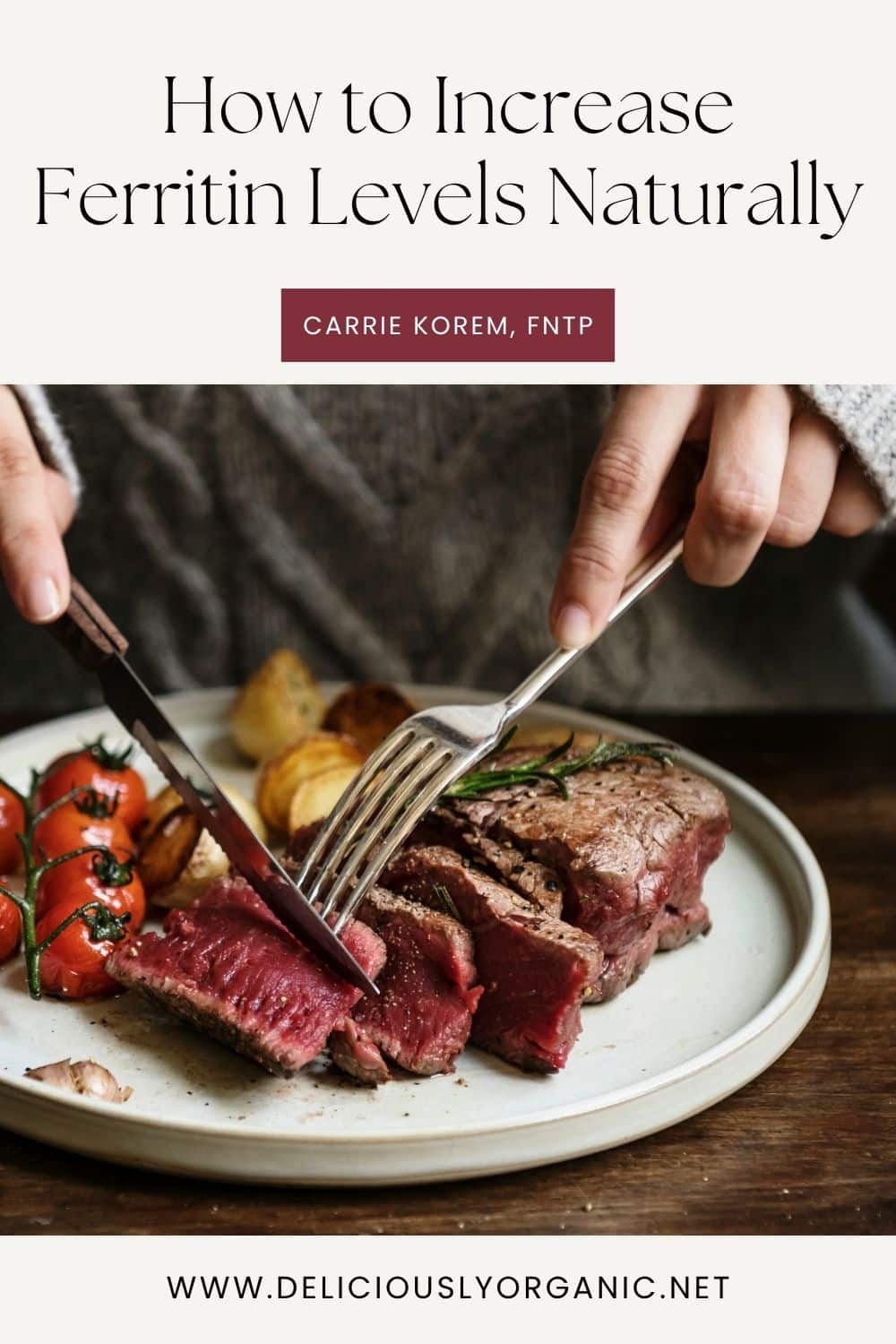
6. Eat heme-iron daily. Some of the best sources of heme iron are liver, beef, chicken, veal, salmon, and pastured eggs. This is super important! And, if you want to get some iron from plant foods like grains or seeds, make sure to soak or sprout before consuming so you can actually use some of the iron in the food.
7. If you have low ferritin and also autoimmunity, food sensitivities or leaky gut, it can be incredibly helpful to take steps to heal your gut. The cells of the digestive system regenerate every 3-7 days, so it doesn’t take long to begin the healing process and increase your iron absorption. Here are 12 ways to heal the gut naturally.
8. Avoid soft drinks that contain phosphoric acid such as Coke, Pepsi and Dr. Pepper. As I mentioned above the phosphoric acid can impair the body’s ability to properly use essential nutrients like iron, magnesium, and zinc.
9. If you’ve done all of the above and ferritin is still low, talk to your practitioner about possible heavy metal toxicity. Or, if you know you have heavy metal overload, take steps to gently detox so you can eventually increase ferritin. I always recommend talking to your practitioner about the best heavy metal detoxification steps, so you can do this safely and without negative symptoms.
Sources:
https://www.nhlbi.nih.gov/news/2024/about-1-4-americans-may-have-inadequate-iron-intake-or-absorption
https://my.clevelandclinic.org/health/diagnostics/17820-ferritin-test
https://pmc.ncbi.nlm.nih.gov/articles/PMC10049453/
https://pmc.ncbi.nlm.nih.gov/articles/PMC2753210/
https://pmc.ncbi.nlm.nih.gov/articles/PMC9219084/
https://my.clevelandclinic.org/health/diagnostics/17820-ferritin-test




If iron, tibc, and saturation levels are high while ferritin is low, what would that indicate? Would increasing ferritin be appropriate in that situation?
When those levels are high, but ferritin is low, I think it’s often best to first focus on supporting the liver to reduce iron in the blood and take the steps listed above to increase ferritin that do not include increasing iron intake or an iron supplement.