Last Updated on July 14, 2025 by Deliciously Organic
I enjoy making homemade yogurt, but for years my version wasn’t as thick as the store-bought variety. So I experimented and found that adding a bit of grass-fed gelatin to the warm milk makes the yogurt thick and creamy.
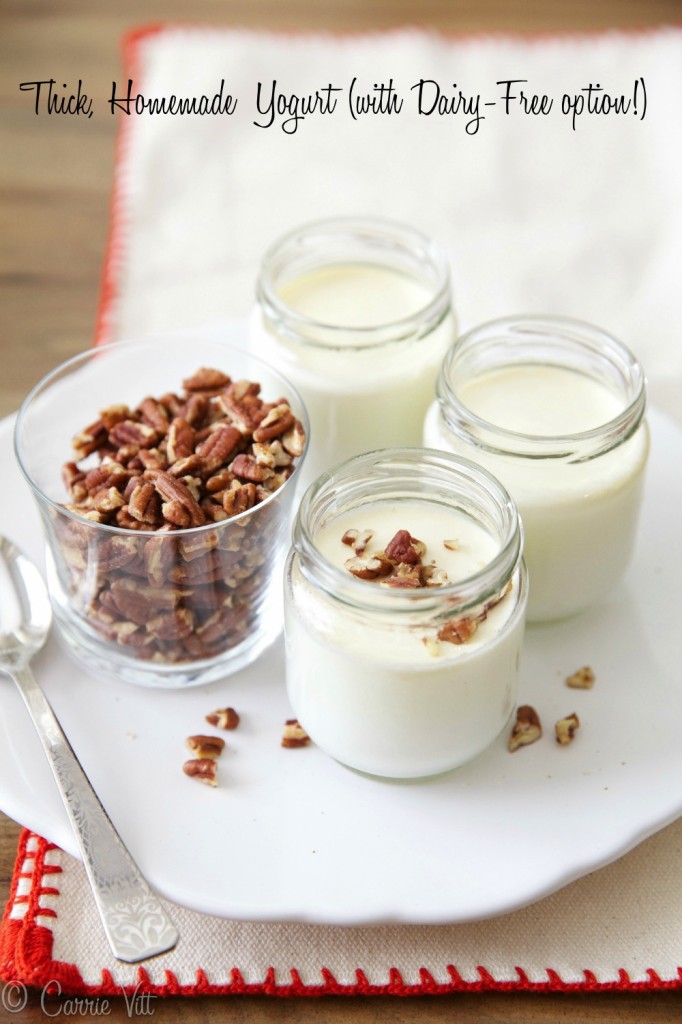
I tested this recipe with coconut milk and fresh unpasteurized milk; both methods worked perfectly. While I don’t like having lots of gadgets in my kitchen, I do love using a yogurt maker. The one I use creates nice single portions of yogurt to put in the fridge. If you don’t have a yogurt maker, check out this oven method.
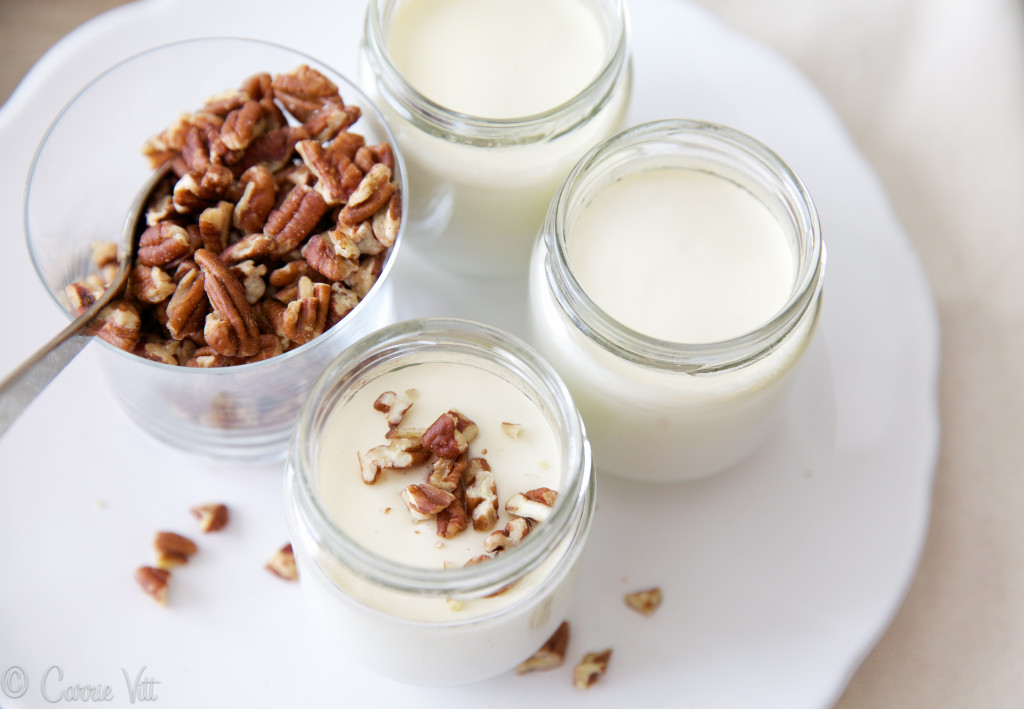
Thick, Homemade Yogurt (with Dairy-Free Options)
If you’re hesitant to use gelatin, this post about the many health benefits of grass-fed gelatin might answer some questions for you.
- Cook Time: 10 minutes
- Total Time: 7 hours
- Yield: Makes about 4 cups
- Category: Snack
- Diet: Gluten Free
Ingredients
Units
- 4 cups whole milk or canned coconut milk
- 1 3/4 teaspoons grass-fed gelatin
- 3 tablespoons yogurt from previous culture (or you could purchase a yogurt starter from Cultures for Health)
Instructions
- Pour milk into a medium saucepan. Heat to 115ºF (this is the thermometer I use). Remove from heat. While whisking, slowly pour in gelatin and continue to whisk until dissolved. Cool mixture to 110ºF. Whisk in yogurt. Pour mixture into your glass yogurt cups if using a yogurt maker, or follow these directions to make in the oven. Incubate at 110ºF for 6 hours. Chill completely. Serve.


Is the coconut milk you use the canned variety or the type in the carton? I avoid the carton type as none I can find locally are carrageenan free :-(. Does this work with canned coconut milk such as Thai Kitchen?
I prefer the canned version because it is less processed and usually doesn’t contain as many preservatives and such. Thai Kitchen, Natural Value or Native Forest will all work well in this recipe.
My kids only like vanilla yogurt. I’ve tried plain with fresh fruit mixed in without success. Any suggestions to make this vanilla flavored? Thank you!
I would add the seeds of a vanilla bean or 1 teaspoon vanilla extract to the milk mixture before culturing. A touch of honey or maple syrup when serving will also help bring out the vanilla flavor. Enjoy! 🙂
It turned out wonderful! Kids enjoyed it! Only complaint is that there wasn’t enough! 😉 I got the mild starter and added a small amount of maple syrup.
I’m so glad you all enjoyed it! I hear ya on not having enough! I’ve been making a batch every other day to keep up! 🙂
I just told my husband last night that I want to try making Yogart again!
My first attempt over a year ago was pretty sad! Would you mind giving recipes for adding fruit and or flavoring such as vanilla? Thank you!
I usually don’t add fruit or sweetener to the yogurt when making it. Instead I top the yogurt with a bit of honey, maple syrup, berries, nuts or seeds after it has been chilled. I’ve read that sweetener in the yogurt mixture can kill some of the good bacteria when it’s culturing, so it’s better to add the sweetener after it’s made. As for vanilla, you could add the seeds of a vanilla bean or a teaspoon of vanilla extract to the mixture before culturing.
Wouldn’t the alcohol or propylene glycol in the extract kill some of the good bacteria, or is it usually too small to matter?
Side note: that propylene glycol in fake vanilla is the main ingredient in antifreeze (the reason it’s poisonous to animals) and has replaced formaldehyde in most embalming fluids.
This recipe doesn’t contain vanilla so I’m not sure what you’re referring too.
I’ve always wanted to make my own! This sounds splendid!
Would it work with almond milk? I have the same yogurt maker and my first attempt at making yogurt was a failure. 🙁 I think the gelatin will surely help and I am anxious to try again.
I haven’t tried it, but I think it would work just fine. The gelatin makes a world of difference! 🙂
My kids love Greek yogurt. Would this be similar?
It’s similar, but not quite as tangy. I’ve even gone as far as adding 1 tablespoon of gelatin to the mixture and loved it. It was even more thick – almost like a panna cotta! 🙂 So, you can definitely play with the amount of gelatin added without fear of the yogurt not turning out.
I know this feed was years ago, but I thought I’d try anyhow: have you ever experimented using a dairy-free culture with dairy milk? Does it work?
I’ve never tried that, so I can’t say. Sorry!
How long does this yogurt last in the refrigerator before going bad?
It keeps for about 8 days or so.
My yogurt maker has been gathering dust in the pantry – I find making kefir so much easier – but this recipe looks delicious and I’ve been looking to use more gelatin. Definitely going to give this a go!
You make this look easy. I can’t wait to try. Thanks!
I am going to order starter from cultures for health. Which one did you use for your tests with coconut milk? I was thinking the vegan one?
I used the traditional, but all of their cultures are great! I’ve used the cream cheese, kefir, and kombucha starters and they have all produced fantastic results!
Hi Carrie
Is there a vegan alternative you would recommend for the gelatin???
Many thanks
Jenni
I haven’t tried it, but I hear that agar agar is a good alternative to gelatin.
Agar agar flakes have been working really well for me. About 2T in 2 cans organic coconut milk. I add 1t vanilla after fermented & it amazing!!
My yoghurt was a complete flop…:-( put into electric yoghurt maker for 6 hours and still liquid… No sign of becoming a solid. I used the carton coconut milk and ordinary gelatin
I used 3 tablespoons of coconut yoghurt as a starter and followed the instructions to the letter…I noticed that when I added the yoghurt it curdled the milk a bit? Is that meant to happen?
Have left for another 2 hours in case it is not long enough… Not hopeful though
Any advice?
Many thanks
Jenni
I suspect it’s the preservatives in the carton coconut milk that might have made this not work. I only tested this with canned coconut milk (I use this because it contains little to zero preservatives) and unprocessed whole milk. Did you bring the yogurt up to 115 and then down to 110? Maybe your candy thermometer isn’t calibrated correctly? I’ve never seen the mixture curdle. What brand of coconut yogurt did you use? Sorry for all of the questions, but the more I know the easier it will be to figure out what went wrong.
Is called CoCo milk for cooking.. And yes I did the temperatures and the yoghurt is called Pura Veda
Will try again with canned and use an organic dairy starter.. I read somewhere that coconut milk is not as sweet so needs a little sugar added to encourage fermentation? Do you agree?
My thermometer is new .. Had a really old one in Celsius only… So shouted myself a new one…
Jenni
I haven’t heard that coconut milk needs the sugar to help with the fermentation. I tested this with coconut milk and it worked great. By the way, the dairy-free yogurts take a bit longer to set in the fridge. So, make sure and chill it overnight before eating (it will look liquid when you take it out of the yogurt maker, but will set in the fridge).
Have you used this method with homage nut milks? Doing a dairy and coconut elimination right now but would like to start using my new yogurt maker and eating yogurt again.
I haven’t tried it, but I think it would work well. I would definitely use a culture to get it all going. Cultures for health has a great dairy-free yogurt starter culture: http://www.culturesforhealth.com/vegan-dairy-free-yogurt-starter.html
That worked well… Might have been the preservatives as you suggested or maybe was the coconut yoghurt I used as a starter.. Not sure. What I am wondering is can I use the new batch as a starter for the next batch? Rather than rely on a dairy based yoghurt.? I am dairy free, so not keen to use it again… Is there a vegan starter that would work do you know?
Many thanks
Jenni
Good to know! I always use the last batch as a starter for the 2nd. Cultures for Health has a great Vegan Culture (keep in mind it has a bit of grain in it). The culture plus the gelatin will ensure a really nice, thick yogurt. Here’s the link for the starter: http://www.culturesforhealth.com/vegan-dairy-free-yogurt-starter.html
I did notice it says the starters can’t be recultured. But they can? Also I cannot do dairy or the vegan starter (I don’t do rice) Is there any options for me to start a yogurt! I really love it but I now became aware of my food sensitivities and can’t have many things 🙁 Thanks!
Is there any reason homemade coconut milk wouldn’t work?
I haven’t tried it, but I don’t see why it wouldn’t work. I would make sure to use a culture instead of a coconut yogurt from the store just to ensure it forms properly.
I too make my own yogurt using a yogurt maker, but I incubate the milk and culture for 24 to 36 hours to minimize the lactose in the yogurt. The yogurt always comes out creamy and thick.
I add chia seeds after the culturing process – after 12 hours, there’s barely a crunch to the seeds so there’s no difference in taste. You can strain the yogurt but I don’t have the energy to use the whey all the time and I hate to think of wasting so much good, organic milk. This was my way of doing it since I have a hard time stomaching the smell of gelatin – many say it’s odourless but I find it vile and hard to get out of my nostrils! Yay to everyone trying this at home – homemade stuff is incomparable to the store stuff.
Interesting technique! I have a mesophilic culture from Cultures for Health (meaning it cultures at room temperature). Since I don’t heat up the milk before culturing, how would you recommend adding the gelatin?
I don’t think there is a way to dilute the milk without heating. Someone at Cultures for Health might have the answer.
I eat my share of yogurt but I’ve never tried to make it myself. I think I can handle this recipe, I’m going to give it a shot.
I’ve read that the cultures need sugar to feed. Should I add a sweetener just to help the cultures live?
There is enough sugar in the whole milk to help feed the culture, so additional sweetener isn’t necessary.
Oh! Just saw the above post-sorry!
Finally! After 3 failed attempts I bought the gelatin you recommend and I woke up to success – I am so happy to have a thick, creamy yogurt (versus a runny mess). Thank you Carrie for restoring my confidence.
Yay!! So the gelatin made that much of a difference? That’s very interesting. I of course didn’t test the recipe with Knox vs. grass-fed gelatin. If it does make that much of a difference, that’s amazing. I wouldn’t have thought so. Glad you woke up to creamy, thick yogurt! I did too! I also made a batch last night. Enjoy! 🙂
I made this today and I’m not sure it came out right. At first it seemed somewhat thick but very lumpy. After stirring to remove the lumps it’s very watery. More the consistency of kefir. It’s also quite tart. I used raw milk. I’m wondering if the milk bacteria overpowered the small amount of yogurt?
How long does it take for the gelatin to thicken the yogurt? I used coconut yogurt and bought the gelatin recommended. I actually made it twice. The first time, I grew some uninvited bacteria on top! Yuck! However, the consistency of that batch was beautiful, like custard. So, I tried again and made sure to sanitize all my utensils carefully with boiling water. But, this time, there was a hard layer on the top that I think is just separating fat? And underneath, it is still pretty runny. It isn’t like water, it’s more like a thick milk or runny pudding. It’s been in the fridge for four hours and is cool…does it just need more time?
Thanks!
What brand of coconut yogurt did you use as the culture? What brand of coconut milk? It could be that there were preservatives or additives interfering with the culturing process. I haven’t had a fat layer rise to the top when I’ve made it with coconut milk so I’m not sure why it separated. It needs to be chilled for at least 6-8 hours for it to fully set.
Have you used pectin as the thickening agent for non dairy yoghurt? Gelatin is such a horrible product I am keen to use a non animal product…
I have also read that milks such as rice milk need to have some additional sugars to feed the culture…
The 2 batches of coconut yoghurt I made with gelatin set well but were like blanc mange rather than a creamy yoghurt…is this how it is supposed to be?
Thanks
Jenni
I haven’t used pectin before. Grass-fed gelatin is a very healthy choice for those who choose to consume animal foods. The yogurt should turn out smooth and thick, like a regular store-bought yogurt. What brand of coconut milk did you use?
Hi Carrie, I used an organic coconut yoghurt. ..can’t remember the brands now.
Jenni
I have already made my yogurt for a few months now and the recipe I use says to heat the milk to 180 degrees to kill off the bad bacteria before introducing the culture. Is the difference in temperature in your recipe due to the gelatin?
I prefer to use fresh milk and only bring the temperature up to a minimal heat so I don’t kill the beneficial bacteria and probiotics. If you’re using pasteurized/homogenized milk, it’s already been heated twice during the processing, so there’s no need to heat it again.
In my experience, heating the milk to almost boiling and keeping there for some time has always produced thicker yogurts, I need to search some better scientific explanation for it but meanwhile
http://www.thekitchn.com/better-homemade-yogurt-5-ways-125442
Are you familiar with Knox gelatin? Is it comparable to the two you have use?
I prefer to use grass-fed gelatin because it comes from grass-fed cows and doesn’t contain any msg (most commercial brands use msg to process the gelatin). It also doesn’t have the nutrients that grass-fed gelatin has. I usually purchase the grass-fed gelatin via Amazon and keep it in a glass jar in the pantry. It keeps well for years.
How do you know if it is grass fed and / or contains msg? For example on the Knox brand, the only listed ingredient is gelatin.
I love this method – it gives the perfect yogurt consistency! Thanks for the tip, Carrie!
Hi!
I was wondering how much culture to add to the coconut milk if I’m just beginning and don’t have the 3 tablespoons from a previous batch? I have Culture starter packets from Body Ecology but I have no idea how much to add. I also have grass fed beef gelatin… Do you think if I added some it would help make my yogurt even thicker? I also was thinking that I could use the two full cans of coconut milk and not have to separate the cream if I used gelatin to make it thicker? Sorry for all the questions!!! I have never done this before can you tell? Thanks for listening! Amy
You can either use a culture or 3 tablespoons from a previous batch. I would follow the instructions on the package. Yes, the gelatin would help make it thicker. There’s no need to separate the coconut milk if you use this recipe. Hope that helps!
thankyou! your so kind to reply! 🙂
My yogurt is firm and set after machine has finished and it’s been chilled.
However, to get the fruit that has settled at the bottom mixed in, I stir it and the yogurt gets very runny, is there a way to stop that? Store bought yogurts don’t seem to have the same problem.
I’m not sure as I haven’t tested this recipe with fruit on the bottom. I would suspect the fruit is releasing moisture into the yogurt.
I love coconut milk yogurt and make it in such a simple way. I put 2 cans of coconut milk in a quart mason jar, open 3-4 probiotic capsules, add them to jar, shake and put on sunny windowsill for 2 days. When it’s thick, I refrigerate. To eat, I add 4-5 drops vanilla creme stevia to a generous serving + fruit and nuts. Yumm!
Fabulous idea! Thanks for sharing!
I have an Easiyo yogurt maker (thermos style). The yogurt I currently make which is dairy I let the milk cool completely before I add the boiling water and incubate it. Would this work with your method? I really want to try the dairy free version and just not sure how it would work?
This might be a stupid question but if you use milk and some yogurt from the store as your starter, do you get probiotics in the yogurt? Over time do you no longer get the probiotics?
if you don’t have a yogurt maker and don’t want to put it in the oven, wrap it in a heating pad on low. Leave it overnight. It’s never failed me. Also if you want it thick just put it over cheese cloth. Greek yogurt is nothing but concentrated regular yogurt. That’s why Greek yogurt costs twice as much.
Hope this helps.
do you also use raw milk to make the yogurt? Do you heat it at the same temperature?
I do! I follow the same recipe when using raw milk.
I’m a nut for homemade yogurt. I’m also a newbie. I have a yogurt maker that holds a litre of milk and a little starter. I turn it on and in about 8 hours, I have yogurt. I usually strain it to get Greek yogurt.
I have a question. Okay, I have a couple. 1) using store bought milk, in my yogurt maker, when would I add the gelatin? 2) Does the gelatin change the texture of the yogurt? (How does it compare to Greek yogurt that was strained?) 3) Can I use rice milk to make yogurt? (I make my own think and creamy rice milk.)
Do you have a thick layer of cream on your yogurt? I used fresh raw milk and followed your recipe. It was very nice, no tang, but had a somewhat hard layer of cream on top. I could stir it in but it didn’t sound like your yogurt had a hard layer.
Yes, it has a hard layer of cream that rises to the top when it’s ready. I personally love this, but you can stir it into the rest of the yogurt if you’d like.
Every time I’ve tried to dissolve gelatin (I use the same one you link to here) in warm liquid, it clumps up. It seems to dissolve much better in cold liquids. Maybe it’s just me? I’d love to start making our own yogurt again, but am nervous to waste expensive milk. Also, do you think it makes a difference that our milk is lightly pasteurized? (it’s grass-fed and nonhomogenized; they have to pasteurize it lightly in order to sell it legally in VA)
Hmm…I’m not sure why it’s clumping. Do you whisk while it’s heating? Lightly pasteurized milk should still work well for this recipe. 🙂
Hello. I am making homemade hon-dairy yogurt. I would like to know where I would find the nutritional value (how many cultures, minerals, etc.) associated with the end product.
Hi Carrie, Have you tried making yogurt in a dehydrator? Mine is the excalibur, and it says you can, but I don’t want to blow it and waste all that raw milk :o) Also, can you use kefir as the starter or does it need to be yogurt?
I’ve never tried that, but it sounds intriguing!
I’ve made many yogurts in the past which rarely ever set and get thick enough to our liking as a family. I’ve finally found the perfect yogurt recipe!! The gelatin thickens it perfectly. I make mine in the Instant pot, pour in milk and push sauté button and stir occasionally until it reaches 115°. Add the gelatin and then let cool to 110° before adding yogurt starter. Stir well and then stick the lid on select yogurt mode for 6 hours, perfect yogurt every time!