Last Updated on February 22, 2024 by Deliciously Organic
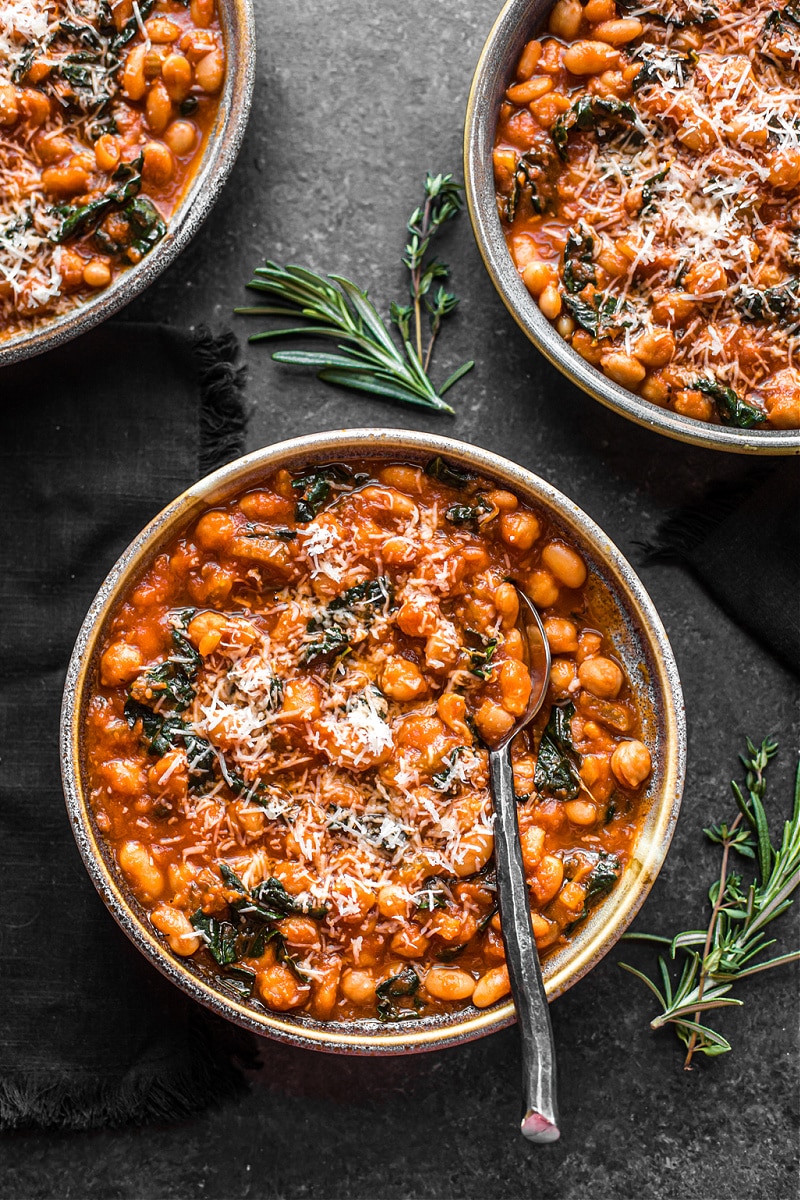
Braised beans are an ultimate comfort food that’s loaded with nourishing ingredients like beans, dark leafy greens, tomatoes, herbs, and bone broth!
Is it ok to eat legumes and nightshades when you have a thyroid disease? I get this question often and have found there is a lot of confusion around the topic.
The short answer is that properly prepared legumes are a healthy addition to a thyroid-healing diet for most people.
Carbohydrates are important for the health of the adrenals and also for the liver in converting the thyroid hormone fT4 to the active form fT3. Of course, you don’t want to eat a super high carb diet, because that can have negative effects on the body, but around 100g of carbs spread throughout the day is a good amount for most people.
An ultra low-carb diet may be trendy right now, but if you have thyroid disease, this isn’t the best idea. Too few carbs can backfire and leave the adrenals fatigued or cause low thyroid conversion in the liver. This is why I’ve always used legumes in my recipes here on the blog and in my cookbooks.
If you’ve been on a strict low-carb diet and aren’t seeing the results you’re looking for, then I recommend talking to your practitioner about adding some properly prepared legumes, lentils, and possibly gluten-free grains back into your diet and see if that changes your symptoms.
What about nightshades?
If you struggle with arthritis or pain in the joints, then it’s best to avoid nightshades. Some common nightshades are eggplant, peppers, potatoes and tomatoes. But, in our practice, we’ve found that if you don’t have these symptoms, then nightshades can be a healthy addition to a thyroid-healing diet.
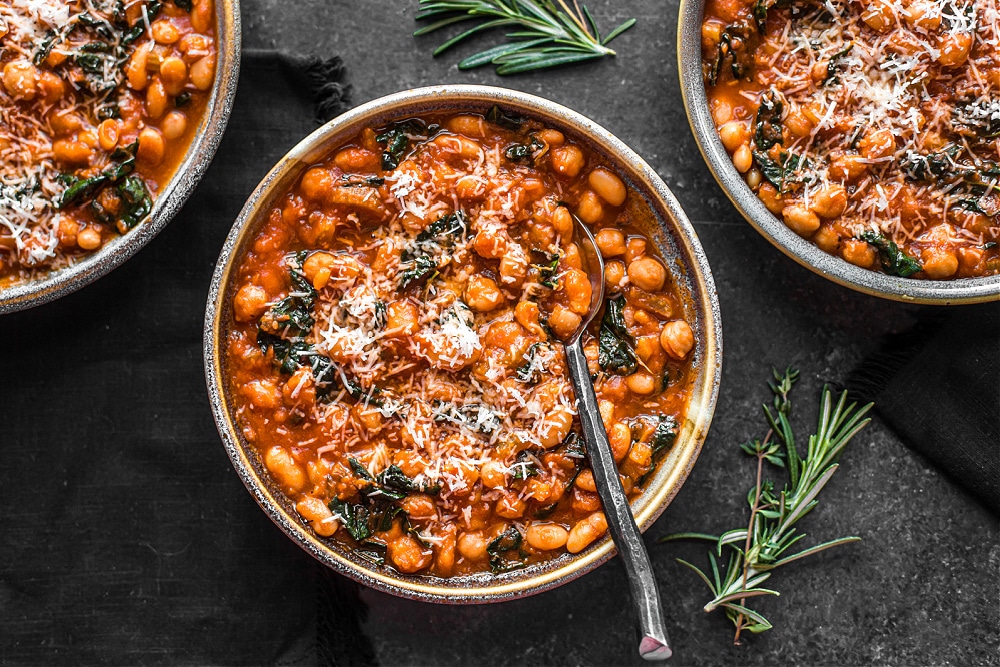
Braised beans are an ultimate comfort food in the wintertime and I love that they make for great leftovers! I cook them on the stove, but I bet this recipe would also work well in the slow cooker.
PrintBraised Beans with Tomatoes and Herbs
- Prep Time: 10 minutes
- Cook Time: 4 hours
- Total Time: 12 hours
- Category: Main Dish
- Diet: Gluten Free
Ingredients
- 1 cup dried cannellini beans, soaked overnight* (you could also use white navy beans)
- 1 cup dried chickpeas, soaked overnight*
- 2 tablespoons unsalted butter or ghee
- 1 onion, chopped
- 3 cloves garlic, chopped
- 2 stalks celery, chopped
- 24 ounce jar crushed tomatoes
- 4 cups chicken stock
- 3 sprigs fresh rosemary
- 3 sprigs fresh thyme
- 1 head Lacinato kale, chopped (you could use chard if you prefer)
- 2 teaspoons Celtic sea salt
- 1/2 teaspoon freshly ground black pepper
- 1/4 cup grated Pecorino Romano cheese (optional)
Instructions
- *Place the cannellini beans and chickpeas in a large bowl. Cover with water and add 2 pinches of baking soda. Let soak overnight at room temperature.
- The next day, drain and rinse the beans. Melt butter in a large pot over medium heat. Add the onion, garlic and celery and cook until just tender, about 5 minutes. Add the crushed tomatoes, chicken stock, drained and rinsed beans, rosemary and thyme and bring to a boil. Reduce the heat to a simmer and let cook until the beans are tender, about 4 hours.
- About 20 minutes before serving, bring a pot of water to boil and add the kale to the boiling water. Cook for 8 minutes and then drain.
- When the beans are tender, stir in the cooked kale, sea salt and black pepper. Sprinkle with Pecorino Romano and serve.
Nutrition
- Serving Size: Serves 8



Wondering if the new Instant Pots alter the nutrition in organic foods. Can’t seem to find an answer.
High heats, such as the heat from an instapot can denature the proteins in food, so I prefer to stick with more traditional methods of cooking.
Do you have information such as scientific studies that indicate how high heat can denature proteins? The chemistry of food is intriguing to me.
Here you go! http://chemistry.elmhurst.edu/vchembook/568denaturation.html
I understood that using a pressure cooker preserves all the vital nutrition in foods, as the steam is not evaporated as in ‘traditional’ crock pot and stovetop cooking.
That’s not possible. Some nutrients can be destroyed with heat whether or not there is evaporation.
You can adjust the temperature on an Instant Pot to anything you like. You can slow cook in one, sauté or pressure cook. It is just like a pot on the stove.
Also, the link you provided is extremely scientific, making it impossible for the normal person to interpret….plus it really doesn’t say anything about it being a negative impact, and that some ‘denaturing’ is for making it “easier for enzymes to digest”.
I think the Chemistry article I linked to is easy to understand. Using a pressure cooker, such as an InstaPot can first denature proteins which then can make it harder for the body to digest the proteins. It can also create too many glutamates which can overstimulate the brain. If you don’t agree and would like to use an InstaPot, that’s totally fine. You can use whichever cooking method you prefer.
I noticed you used a variety of beans other than those listed in the recipe. Could you let me know the combination you used? Thank you.
I used Cannellini and Chickpeas in the recipe.
Thank you. I just noticed the colander in the blog had a number of other beans, maybe pinto, red kidney beans, and yellow split peas. Just wondering if you’ve used this combo to make this recipe<3
Oh! Because I was talking about if it’s ok to use legumes, I included a pic of different beans. Sorry for the confusion! 🙂
Lol…Thank you.
I wonder about spinach in the place of kale does it also need to be boiled separately first?
I would blanch it, since it’s not as fibrous as kale.
I love this recipe! And am looking forward to making it! I had another question about the greens. I’ve always just added my greens into my pot of soup/stew and had it cook along with the rest of the ingredients in the pot. That way the nutrients that are leached out when cooking stays in the pot. Is cooking them in this way detrimental to the rest of the ingredients in the pot? Thanks so much!
The goitrogens are released when you cook the greens, so it’s best to first boil them and then add them to the beans.