Last Updated on July 20, 2026 by Deliciously Organic Editor
Finding the best egg substitute for baking can feel impossible. Most replacements I tried were either too gummy, changed the flavor of the recipe, or left me with cookies that fell apart.
If you’ve searched for a healthy egg replacement, you’ve probably come across flaxseed “eggs.” While flax is a popular option, I personally avoid it for a few reasons:
- Low smoke point: Flaxseed oil has a low smoke point and it oxidizes easily in high heat (like baking), which isn’t great for your health.
- Hard on digestion: Many people with gut issues—or those sensitive to eggs—struggle with seeds unless they’ve been properly soaked to reduce phytic acid.
- Also, flaxseed is something we don’t want to consume too often because it can cause hormone imbalances, especially when it comes to estrogen.
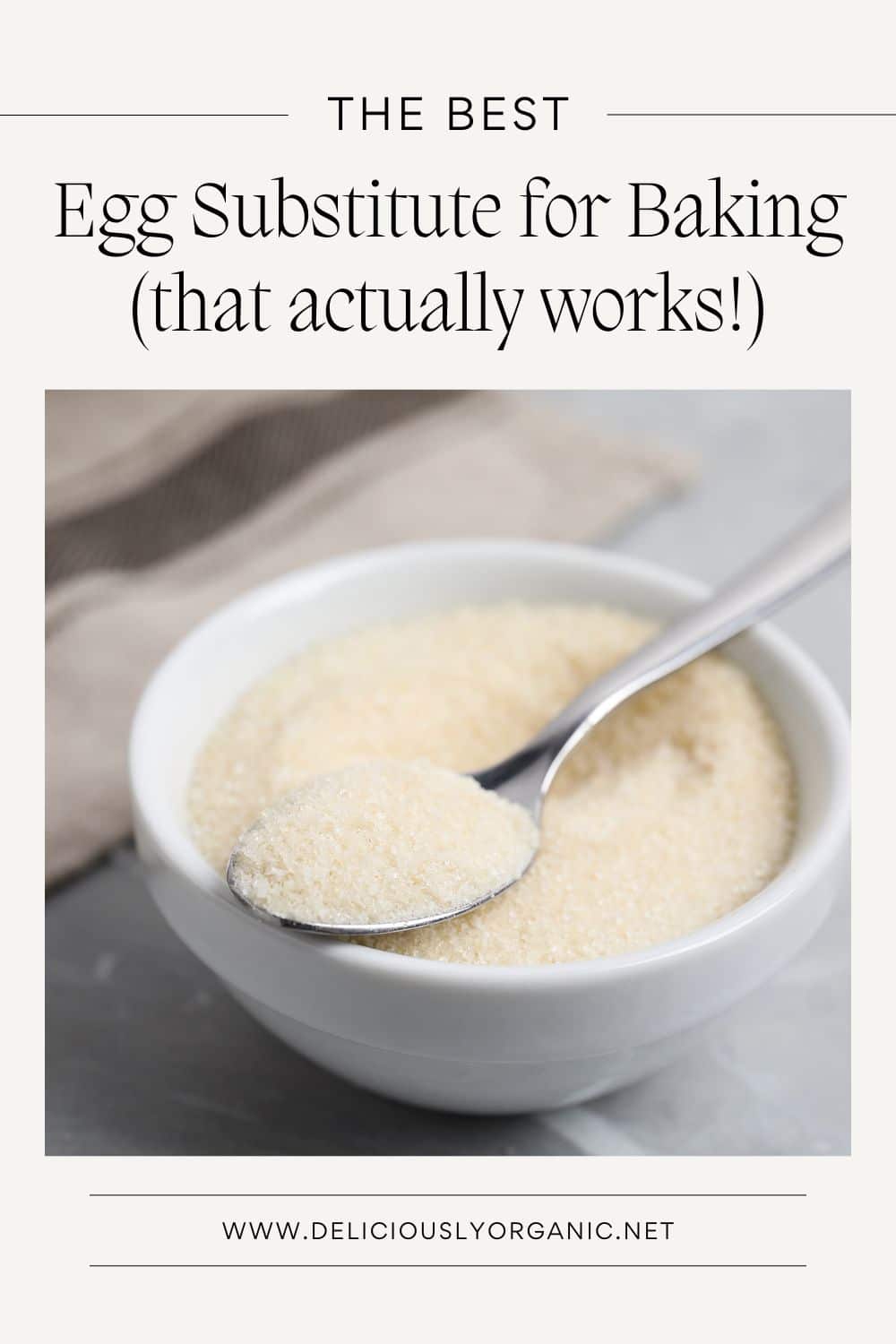
After testing countless recipes, I finally found an egg substitute that really works: a combination of grass-fed gelatin and hot water. Not only does it mimic the binding power of eggs beautifully, but it also offers added health benefits.
Why Gelatin Makes the Best Egg Replacement
When mixed with hot water, gelatin turns frothy and works as a natural binder, giving baked goods structure without the gumminess other substitutes can cause.
Plus, if you use high-quality, grass-fed gelatin (I love Bernard Jensen grass-fed gelatin), you’ll also support your gut, skin, hair, nails, and immune system while baking. Talk about a win-win!
How to Use Gelatin as an Egg Substitute
This simple recipe is perfect when you need to replace 1 to 2 eggs in a baking recipe. (Beyond that, things can get a little too soft and gummy.)
I tested this method in my grain-free chocolate chip cookies and reader-favorite gluten-free pizza, and it worked like a dream. Just use one gelatin egg in place of a real egg and slightly reduce the extra gelatin called for in the recipe.
Tips for Success
- Use this recipe for cookies, muffins, quick breads, and cakes that call for 1–2 eggs.
- Always choose high-quality, grass-fed gelatin for the best texture and health benefits.
- Add the gelatin “egg” right before mixing into your recipe so it doesn’t set too quickly.
Gelatin Egg Recipe
Ingredients
-
- 1 1/4 teaspoons unflavored, grass-fed gelatin
- 3 tablespoons hot water
Instructions:
-
- Place hot water in a small measuring cup.
- Add the gelatin and quickly blend using an immersion blender to whip until frothy and white (about 30 seconds).
- Add immediately to your baking recipe in place of an egg.
- That’s it! A simple, clean, and nourishing egg substitute for baking that’s gluten-free, grain-free, dairy-free, and seed-free.

If you’ve been frustrated with egg-free baking, give this gelatin egg substitute a try. It’s easy, healthy, and creates baked goods that are chewy, soft, and delicious—without eggs, seeds, or weird textures.
I hope you find this recipe helpful for your egg-free baking!
PrintThe Best Egg Substitute for Baking (That Actually Works!)
I’ve used this to substitute 1-2 eggs in many baking recipes and it’s worked perfectly every time!
- Prep Time: 5 minutes
- Total Time: 5 minutes
- Yield: Makes 1 gelatin egg
Instructions
- Place the gelatin and hot water in a small liquid measuring cup. Put the hand immersion blender into the measuring cup and blend the ingredients together until it turns white and frothy, about 30 seconds. Add immediately to your baking recipe when it calls for an egg.
Notes
I only test the recipes on my site with the listed ingredients and measurements. If you would like to try a substitution, you are welcome to share what you used and how it turned out in the comments below. Thanks!
Nutrition
- Serving Size: 1
Photo credit: I was short on time this week so I used a photo from Big Stock Photo.


Most people who don’t eat eggs are vegetarian or vegan. We don’t eat gelatin.
I believe Carrie specifically cited those who cannot eat eggs due to allergies, insensitivities or other intolerances – not ethical reasons. For someone like myself with an anaphylactic egg allergy, this is a welcome substitution for flax and chia ‘eggs’ which aren’t always suited for some recipes.
Perhaps another egg substitute would be a better fit for you. Potato starch + water can also be used with good results if flax or chia seeds aren’t your thing.
Thank you for posting both the comment and the alternative. It answered more questions that I had, too.
Try Aquafaba, The liquid from chickpeas. Lots of “Google“ information on it.
I really appreciate your efforts in finding a good egg free alternative to share with us all. For those of us with egg allergies, this is a really helpful alternative!
Wow, so interesting. Thanks so much for sharing!
I’ll definitely give this a try! I’ve only been egg- free for a couple of months (food sensitivity) so any help is MOST WELCOME!!!! Thanks again ~
Thanks, Sue! 🙂
I just found out I have an egg sensitivity too, which feels devastating to an egg lover like myself. I will definitely be giving this a try. I don’t like the “flax egg”, since I also have IBS, so this version may prove to be exactly what I’m looking for.
Thank you so much for this option!! Flax and chia seed don’t work for some recipes and can’t have eggs due to food allergies.
Thanks Carrie! I used yesterday in my grain free pancake recipe and worked great. Can’t wait to try in some other recipes. Can I share a link on my website for your egg replacement recipe? Blessings, Lisa
Perfect timing – was just looking for a replacement to bake a batch of cookies for an egg free friend. Thanks, Carrie!
You’re welcome! 🙂
Hi what’s a good egg replacement for making a grain free paleo bread? The receipt I have requires 7 eggs but don’t want to use eggs or flax. Please help and thank you
If it’s a Paleo bread with mostly almond or another nut flour and only uses 2 or less eggs, then this would be a great substitute. For a bread recipe that utilizes coconut flour, the recipe will need lots of eggs, so this gelatin egg won’t be a good replacement.
So what else is the gelatin used for ?
Some times I don’t have an egg, so then can I use the gelatin ? Like for cakes or cookies, or does it not work in regular flour ?
I’m trying to make these cookies for my grandsons who have nut and egg allergies. I was so excited! However, that excitement changed quickly after attempting to make the “gelatin egg”. I have an emersion blender AND several small measuring cups. I’ve tried them all. with only 3 Tbl of water and the small amount of gelatin, the blender’s blade CAN’T reach the concoction. 🙁 I’ve tried way too many times. It “sets” so quickly and I have to dump it all out. 🙁 Any suggestions??
Hmm…Maybe use a small blender and have the blender on as you slowly add the gelatin to the hot water? I’m using a hand immersion and small measuring cup, but haven’t had the same issue. I guess your immersion blender is much bigger than mine! 🙂
I just make mine in a large 4 cup measuring bowl using a fork or whisk. No immersion blender required.
I just make mine in a large 4 cup measuring bowl using a fork or whisk. No immersion blender required.
I just tried this to make Gaps Intro pancakes (2 gelatin “eggs,” 1/4 c sunbutter, 1/2 c cooked butternut squash). The gelatin eggs didn’t seem to do a whole lot to bind the batter together, but the results were pretty okay. It took a lot longer to “cook” than gaps pancakes I’ve made with real eggs. The taste was my favorite part. I enjoyed the flavor much more than the eggy grain free pancakes I’ve had in the past. Although after over 2 weeks of eating nothing but meat, vegetables, and squash on Intro, maybe my standards aren’t quite what they would be normally. I bet these gelatin eggs might function better than eggs in other sorts of recipes.
This substitution won’t work perfectly for every single recipe, but as you noticed, it’s a great stand-in! I’m glad you enjoyed the pancakes! 🙂
What if you try baking the pancakes instead?
Curious if you only use 1 ¼ tsp – it seems like everything I’ve seen people use 1 tbs? Just wanted to verify before trying. Thanks for the immersion blender tip.
The recipe is written correctly. I found that was the ratio that worked best!
Yes! I still use it to this day!